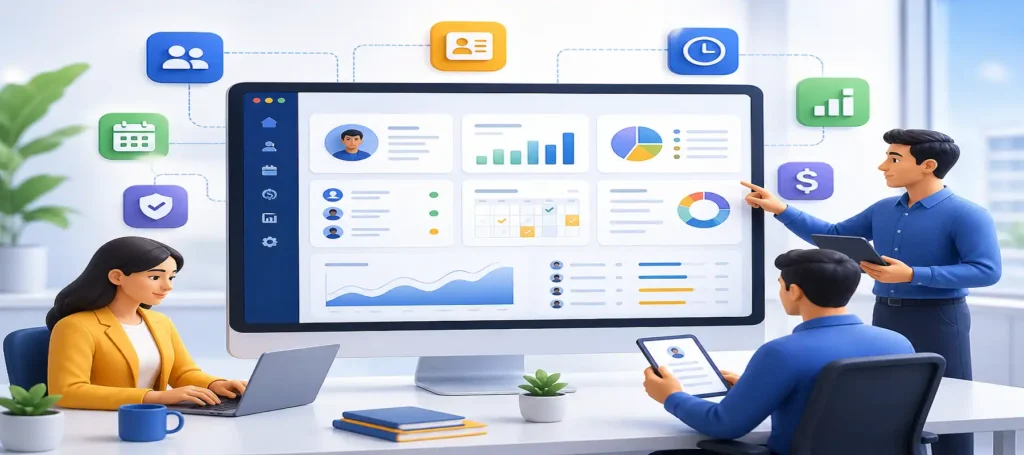
Running a business with 10 employees is manageable. Running one with 80, 200, or 500 employees without the right system? That is where things start falling through the cracks. Attendance gets miscounted. Payroll runs late. Performance reviews pile up in someone’s inbox and never get done. Leave requests get lost in WhatsApp threads. If any of this sounds familiar, you are not alone — and you are not stuck.
The answer is not hiring more HR staff. The answer is smarter technology. Specifically, it is a well-built, custom HRMS software solution that actually fits the way your company works — not a one-size-fits-all tool that forces your team to adapt to it.
At WB Tech (Webeside Technology), we have built custom HRM tools for businesses across industries, and in this post we want to walk you through everything you need to know — what HRMS is, why custom-built beats off-the-shelf, what features matter, and how to get started without the headache.
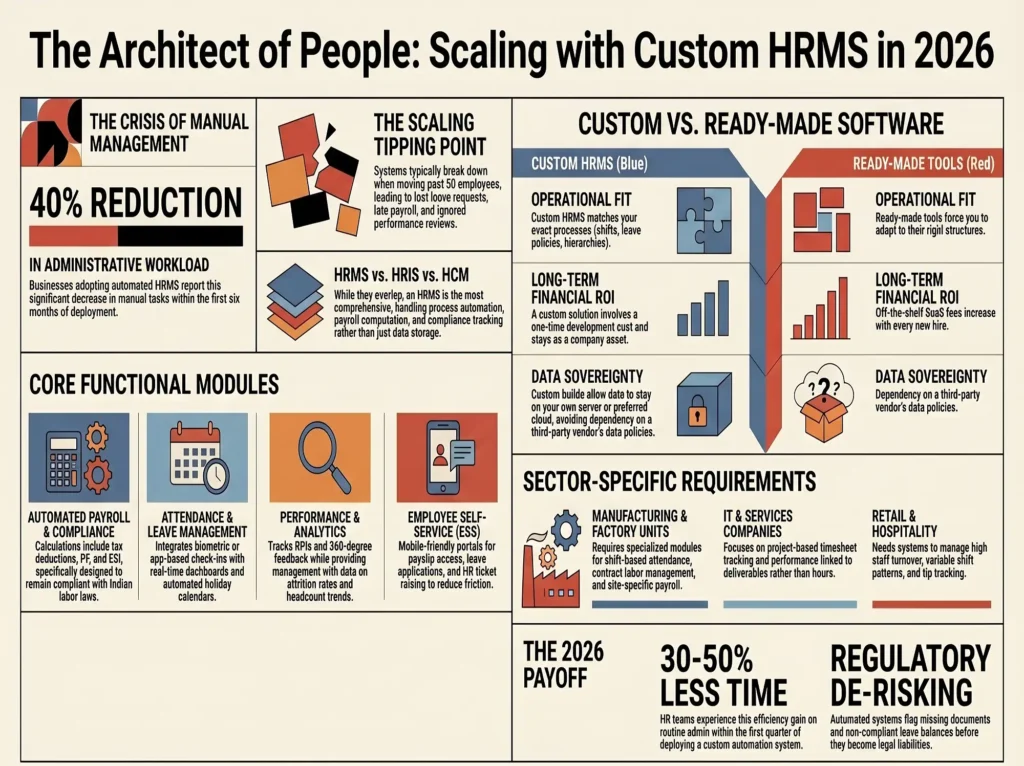
| Quick Stat: Businesses that adopt automated HR management systems report up to 40% reduction in administrative HR workload and a measurable improvement in employee satisfaction scores within the first six months of deployment. |
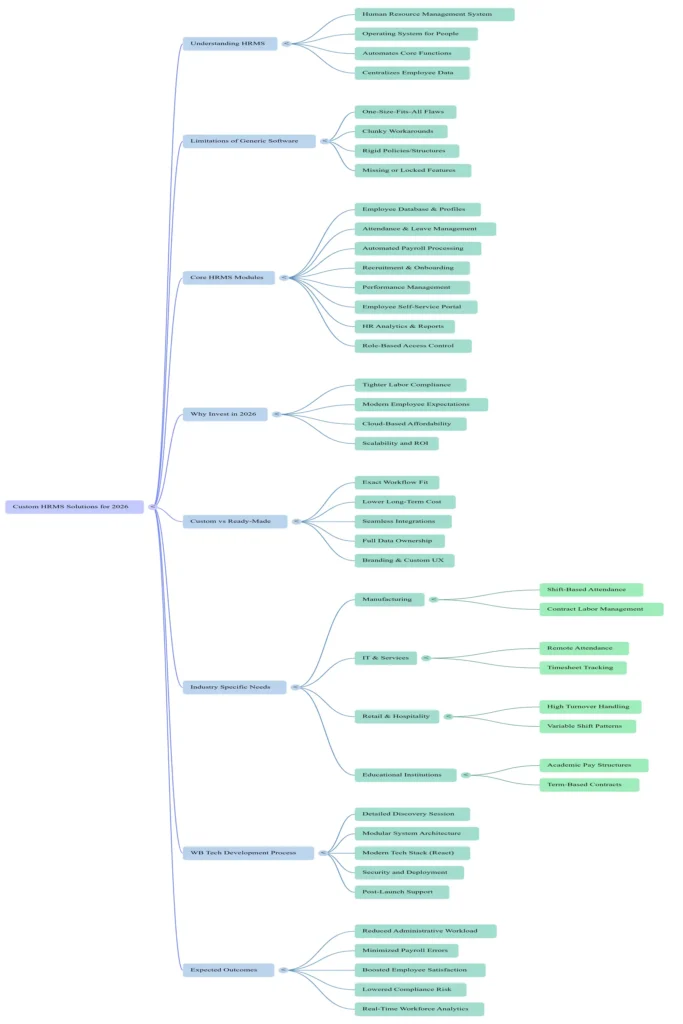
HRMS stands for Human Resource Management System. It is a software platform that centralises and automates the core functions of your HR department — from hiring and onboarding to attendance, payroll, performance, and even employee exit processes.
Think of it as the operating system for your people. Just like your accounting software handles invoices and taxes, your HRMS handles everything related to your workforce. And when it is built right, it connects all these functions so your HR team is not jumping between five different tools and two spreadsheets to do one task.
Some businesses confuse HRMS with HRIS (Human Resource Information System) or HCM (Human Capital Management). While they overlap, an HRMS is typically the most comprehensive — it handles not just data storage but actual process automation, payroll computation, compliance tracking, and analytics.
There are dozens of ready-made HR software products in the market. Some are globally known brands. And yet, businesses keep coming to us frustrated with them. Why? Because off-the-shelf HRMS tools are designed for an average company that does not exist.
Your company has its own shift structures, leave policies, appraisal cycles, department hierarchies, and reporting needs. A generic tool will either not support some of these features or force you into clunky workarounds. You end up paying for modules you do not need while the features you do need are missing or locked behind expensive enterprise plans.
Custom HRMS software development solves this by building the system around your actual workflows, not the other way around. You get exactly what you need, nothing more, nothing less — and the system grows as your company grows.
Before jumping into development, it helps to understand what a strong HR management system should cover. Here are the modules that matter most:
| �� Employee Database & ProfilesCentralised employee records with documents, contracts, emergency contacts, roles, and full history — all in one place. | �� Attendance & Leave ManagementBiometric or app-based check-ins, leave request workflows, holiday calendars, and real-time attendance dashboards. |
| �� Payroll ProcessingAutomated salary calculations with tax deductions, PF, ESI, bonuses, and payslip generation compliant with Indian labour laws. | �� Recruitment & OnboardingJob postings, applicant tracking, interview scheduling, offer letters, and digital onboarding checklists. |
| �� Performance ManagementGoal setting, KPI tracking, 360-degree feedback, appraisal cycles, and manager review workflows. | �� Employee Self-Service PortalMobile-friendly portal where employees can apply for leaves, view payslips, update details, and raise HR tickets. |
| �� HR Analytics & ReportsAttrition rates, headcount trends, leave utilisation, cost per hire — real data to make better workforce decisions. | �� Role-Based Access ControlDifferent access levels for employees, managers, HR admins, and top management to protect sensitive data. |
Depending on your business type, you might also need features like shift scheduling, training management, expense reimbursement tracking, or integration with your existing accounting software. A good HRMS development company will scope all of this before writing a single line of code.
The conversation around digital transformation has been going on for years, but 2026 is different. The regulatory environment in India has tightened around labour compliance — from EPF and ESI filings to state-specific rules that differ between Haryana, Maharashtra, Karnataka, and other states. Keeping track of these manually is not just tedious, it is a liability.
At the same time, employees’ expectations have shifted. People who join your company in 2026 are used to clean, fast, mobile-first experiences in every other area of their lives. When your HR process means filling out paper forms or chasing HR over WhatsApp for a payslip, it creates friction that affects both productivity and retention.
Cloud-based HR management software also became far more affordable with the rise of SaaS development models. You do not need to invest in heavy infrastructure. A well-built system can be hosted on the cloud, accessed from any device, and scaled up as your headcount grows — all at a predictable cost.
We get this question constantly: ‘Why should I build custom when I can just subscribe to an existing tool?’ Fair question. Here is the honest answer:
• Fit: Custom HRMS matches your processes exactly. Ready-made tools make your processes match theirs.
• Cost over time: Per-user SaaS fees add up fast as your team grows. A custom solution has a one-time development cost and stays yours.
• Integrations: Custom systems integrate cleanly with your existing ERP, CRM, accounting tools, or third-party APIs. Off-the-shelf tools often charge extra or simply do not support your stack.
• Data ownership: With a custom build, your data stays on your server or your preferred cloud. With SaaS products, you are dependent on the vendor’s data policies.
• Branding & UX: A custom HRMS can carry your brand and be designed for your employees’ specific workflow, reducing training time significantly.
That said, custom development is not right for every business at every stage. If you are a 10-person startup, a ready-made tool may be perfectly adequate for now. But if you are scaling past 50 employees or managing complex HR workflows, the investment in a custom human resource management system pays for itself quickly.
Shift-based attendance, contract labour management, site-specific payroll, and compliance reporting are non-negotiable in manufacturing. Generic software almost always fails here. A custom HRMS built for your plant’s reality — including biometric integrations, multi-shift scheduling, and overtime calculations — makes the difference.
Flexible work hours, remote attendance, project-based timesheet tracking, and performance linked to deliverables rather than hours — these are the HR realities of tech companies. A well-designed employee management software for IT firms handles all of this smoothly.
High staff turnover, part-time employees, variable shift patterns, tip tracking, and seasonal hiring make HR particularly complex in retail and hospitality. Custom tools built for these industries save hours every week and dramatically reduce compliance errors.
Managing academic and non-academic staff with different pay structures, term-based contracts, examination duties, and student-staff ratio compliance calls for an HR system that understands education-specific rules — something most off-the-shelf tools simply do not.
At Webeside Technology, we do not sell a product. We build solutions. Our HRMS development process starts with a detailed discovery session where we map out your current HR workflows, identify pain points, and understand your compliance requirements. From there, we design a system architecture that is modular — meaning you start with the features you need today and add more as your business grows.
We build using modern, scalable tech stacks — React on the frontend for a clean, fast user experience, and robust backend systems that handle high volumes of data reliably. Our HRMS solutions are mobile-responsive by default, and we always build with security best practices in mind — because your employee data deserves that protection.
We also handle deployment, training, and post-launch support. Getting a system built is one thing. Getting your team to actually use it is another — and that is a gap many development vendors ignore. We do not.
If you have been thinking about upgrading your digital presence beyond HR tools, you might also want to read our earlier post on why every small business needs a digital marketing strategy in 2026 — because your HR platform and your online presence are both pieces of the same business growth puzzle.
If you are ready to move forward, here are the questions you should be walking into that first conversation with:
1. How many employees are we managing now, and how many do we expect in two years?
2. What are our most painful HR tasks today — the ones eating the most time or causing the most errors?
3. Do we have existing software (ERP, accounting, CRM) that the HRMS needs to integrate with?
4. What compliance requirements are specific to our industry and state?
5. Do we need a mobile app for employees, or is a mobile-responsive web portal sufficient?
6. What level of analytics and reporting does management need?
7. Who internally will own and manage the system after launch?
The clearer your answers, the faster and more accurately we can scope and build the right solution for you.
This is the question everyone wants answered, and the honest answer is: it depends. A basic HRMS covering attendance, leave, and payroll for a 50-person company looks very different from a full-featured platform with recruitment, performance management, analytics, and mobile apps for a 500-person organisation.
At WB Tech, we make sure you get value at every price point. We work with startups, mid-sized businesses, and larger enterprises — and we have pricing structures that make custom HR software development accessible even if you are not a large corporation. Visit our pricing page or get in touch for a free estimate tailored to your specific requirements.
Here is what businesses typically experience after deploying a properly built HR automation software:
• HR teams report spending 30-50% less time on routine administrative tasks within the first quarter.
• Payroll errors drop significantly because calculations are automated and cross-checked against attendance data automatically.
• Employee satisfaction improves because self-service features give people visibility and control over their own HR information.
• Compliance risk reduces because the system flags issues — missing documents, overdue appraisals, non-compliant leave balances — before they become problems.
• Management gets real data. Not intuition, not anecdote — actual workforce analytics that inform hiring, retention, and training decisions.
| Module Name | Primary Purpose | Key Functionalities | Target Users | Automation Benefit | Industry Applicability |
|---|---|---|---|---|---|
| Attendance & Leave Management | Track employee presence and manage time-off requests. | Biometric or app-based check-ins, leave request workflows, holiday calendars, and real-time attendance dashboards. | Employees, Managers, and HR Admins | Eliminates miscounted attendance and lost leave requests; reduces administrative workload by up to 40%. | Manufacturing (biometric integration and multi-shift scheduling); IT (remote attendance and flexible hours). |
| Payroll Processing | Automate salary distribution and legal compliance. | Automated salary calculations, tax deductions (PF, ESI), bonuses, and payslip generation compliant with Indian laws. | HR Admins, Finance Department, and Employees | Significant reduction in payroll errors; prevents late processing; ensures compliance with state-specific labour laws. | Manufacturing (site-specific payroll and overtime); Retail (tip tracking); Education (term-based contracts). |
| Recruitment & Onboarding | Manage the talent acquisition lifecycle and new hire integration. | Job postings, applicant tracking (ATS), interview scheduling, offer letters, and digital onboarding checklists. | HR Admins, Hiring Managers, and Candidates | Reduces cost per hire; replaces paper forms with digital experiences; prevents hiring process delays. | Retail & Hospitality (high staff turnover and seasonal hiring). |
| Performance Management | Monitor and evaluate employee growth and productivity. | Goal setting, KPI tracking, 360-degree feedback, appraisal cycles, and manager review workflows. | Managers, Employees, and HR Admins | Prevents review backlogs; flags overdue appraisals; links performance outcomes to specific deliverables. | IT & Services (project-based timesheet tracking and deliverable-linked performance). |
| Employee Self-Service Portal | Empower employees to manage their own data and requests. | Mobile-friendly portal for leave applications, viewing payslips, updating personal details, and raising HR tickets. | Employees | Improves employee satisfaction through visibility and control; reduces HR time spent on routine queries. | General (suitable for mobile-first workforce expectations in 2026). |
| HR Analytics & Reports | Provide data-driven insights for workforce decision-making. | Tracking attrition rates, headcount trends, leave utilisation, and cost per hire metrics. | Top Management and HR Admins | Replaces intuition with real data; enables informed decisions on hiring, retention, and training. | Education (student-staff ratio compliance reporting). |
| Bottom line: A great HRMS does not just make HR easier — it makes your entire organisation run better. When your people management is smooth, everything downstream — productivity, culture, growth — gets easier too. |
If your HR department is still running on spreadsheets, WhatsApp groups, and manual processes, the cost of inaction is higher than you realise. Every hour your HR team spends on administrative work is an hour not spent on strategy, culture, or hiring the right people. Every payroll error or compliance miss is a reputational and financial risk that compounds over time.
Custom HRMS software development services are no longer the exclusive domain of large enterprises with big IT budgets. In 2026, the tools and expertise to build a proper HR management system are accessible to businesses of almost any size — and the ROI is measurable within months, not years.
At Webeside Technology (WB Tech), we build HRM tools that your team will actually use, your HR department will love, and your management will trust. Whether you are starting from scratch or replacing a system that has outgrown you, we have the experience and the approach to get it right.
Let’s build something that works for your people — and for your business.
| Ready to Build Your HRMS?Tell us about your HR challenges and we’ll show you exactly what a custom solution can look like for your business. Free consultation, no commitment.Get a Free Consultation -> |
WB Tech — Webeside Technology
We build websites, apps, SaaS tools, and digital marketing campaigns for businesses that mean business. Based in Faridabad, Haryana — serving clients across India and globally.
webesidetechnology.in | Info@webeside.in | +91 88-6087-6087
Thank you for your interest! A program advisor will reach out to you shortly to provide more information and assist you with your next steps.
📞 Schedule A Call

At WB Tech, we craft stunning websites and powerful marketing campaigns that drive real business results.